
What Is Profiloplasty and Who Needs It?
Profiloplasty is surgery planned to balance your side profile, mainly the nose, lips and chin, as one unit. Most often it means a rhinoplasty and a chin augmentation done in the same operation.
Otoplasty in Islamabad with Dr. Umbreen Munir Minhas reshapes the ear cartilage so ears that stick out sit closer to the head, while keeping their natural curves and folds.

Medically reviewed by Dr. Umbreen Munir Minhas, MBBS, FCPS (Plastic Surgery). Last updated October 2026.


 Trustindex verifies that the original source of the review is Google.
 Trustindex verifies that the original source of the review is Google.
 Trustindex verifies that the original source of the review is Google.
 Trustindex verifies that the original source of the review is Google.
 Trustindex verifies that the original source of the review is Google.
 Trustindex verifies that the original source of the review is Google.
 Trustindex verifies that the original source of the review is Google.
 Trustindex verifies that the original source of the review is Google.
 Trustindex verifies that the original source of the review is Google.
 Trustindex verifies that the original source of the review is Google.
Otoplasty, also called ear pinning or ear reshaping, is prominent ear correction surgery. It folds, reshapes or sets back the cartilage of the outer ear so the ear lies at a natural angle.
Prominent ears affect about 5% of people and are the most common ear shape difference present at birth.

The antihelix is the curved fold inside the upper ear. When it does not form properly, the upper half of the ear stands away from the head, and it often runs in families.
The concha is the bowl next to the ear canal. When it is too deep, it pushes the central ear forward, and a deep bowl often appears together with a weak fold.
Children are often teased about their ears once they start school, and this tends to increase after age 7. The ear reaches about 90% of adult size by age 5 or 6.
One ear may stick out more than the other, or an injury may change its shape. Correcting the more prominent ear brings both sides closer to a matching position.
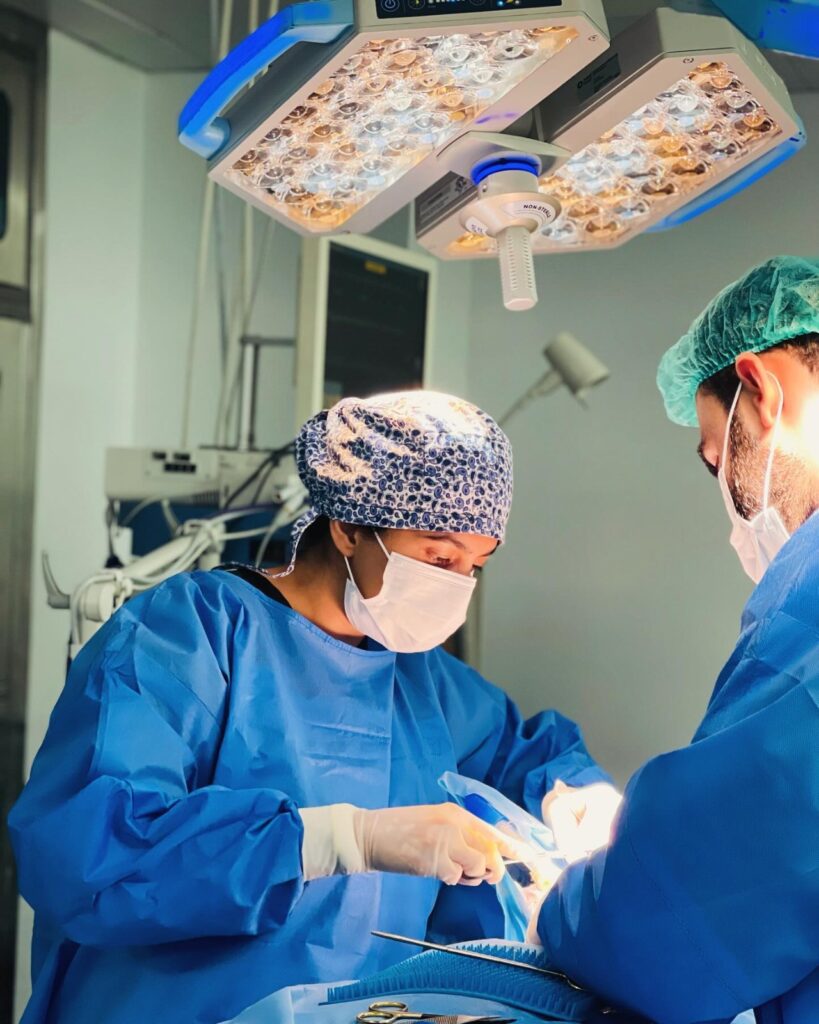
Permanent stitches placed through the back of the cartilage bend it into a soft antihelical fold. This sets back the upper ear without cutting through the cartilage.
The deep ear bowl is stitched closer to the bone behind the ear, or a small crescent of cartilage is removed. This brings the middle of the ear back.
A thin layer of tissue from behind the ear is laid over the stitches. In a study of 365 patients, ears returned forward in 6.5% with this flap versus 29.6% with stitches alone.
When the lobe still sticks out after the cartilage is corrected, a small amount of skin is removed behind it. This keeps the whole ear in one smooth line.
The ears lie flatter with a soft, natural fold, so they no longer catch attention. A small difference between the two sides is normal, as no two ears match exactly. Photos below are shared with consent.

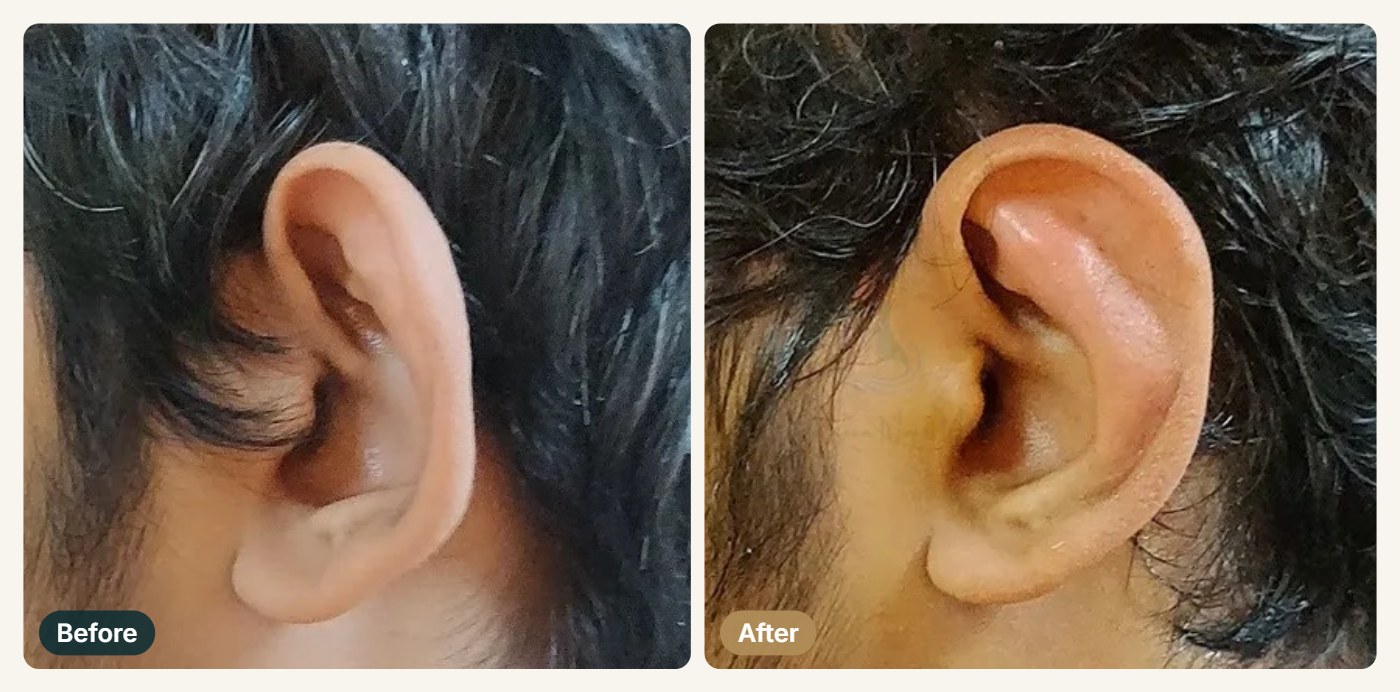
Illustrative images. See Dr. Umbreen Munir Minhas’s patient results in the before and after gallery.
Dr. Umbreen Munir Minhas measures how far each ear stands from the head and checks the fold and the bowl. For children, she also makes sure the child wants the change.
Children should not eat for a set number of hours before general anesthesia. Adults should stop smoking and stop aspirin and herbal supplements 2 weeks before.
The cut is made in the crease behind the ear, where it stays hidden. Children usually sleep under general anesthesia, adults often have local, and it takes about 1 to 2 hours.
Most patients go home the same day with a padded head bandage over both ears. The ears may ache or throb on the first night, which painkillers usually control.
| Time After Surgery | What to Expect |
|---|---|
| First week | The head bandage stays on, then the bandage and any stitches come off. |
| Weeks 1 to 2 | Most children return to school and adults to work. |
| Weeks 4 to 6 | Swimming can usually start again. |
| Around week 12 | Contact sports such as football, cricket and martial arts can resume. |
Wear a soft headband at night for about 4 weeks so the ear cannot fold forward in your sleep. The ears may stay numb for a while, so keep hot hair dryers away.
A review of cartilage-sparing otoplasty found serious problems uncommon. Dr. Umbreen Munir Minhas explains each risk to patients and parents before consent.
It changes the angle and fold of the ear, not its overall size. A very large ear needs a different reduction technique, and exact symmetry between both ears is not possible.
Your fee is confirmed after consultation, once the technique and anesthesia are agreed. Ask for one written estimate covering surgeon, anesthesia and facility.
| Factor | How It Affects Your Fee |
|---|---|
| One or both ears | Correcting one ear costs less than both. |
| Technique | Adding a fascial flap or conchal setback takes more time. |
| Anesthesia | General anesthesia for children costs more than local for adults. |
| Earlobe work | Setting back the lobe is an added step. |
Quotes for ear surgery in Pakistan are often given per ear, so check whether a price covers one ear or both.

Her public profile lists congenital and traumatic ear problems, so she works with ear cartilage in both cosmetic and reconstructive cases. Mothers often find it easier to discuss a child’s ears with a female surgeon.
Ear moulding uses a small splint taped to a newborn’s ear while the cartilage is still soft from the mother’s hormones.
| Feature | Otoplasty | Newborn Ear Moulding |
|---|---|---|
| Suitable age | Children and adults | The first weeks after birth |
| How it works | Cartilage is reshaped and stitched | A splint holds the ear in shape |
| Anesthesia | Needed | Not needed |
| Success | Lasting in most patients | About 93% in a pooled review |
| Ideal timing | Any time once the ear has grown | Started before 6 weeks: 96% versus 82% later |
If your baby’s ears fold forward, see a plastic surgeon early, because the moulding window closes within weeks.
Dr. Umbreen Munir Minhas sees patients privately at Omer Diagnostic & Specialist Clinics (ODC), 12-A, LG Floor, CBC Plaza, G-8 Markaz, Islamabad, Monday to Saturday, 11:00 AM to 6:00 PM.
For a child, bring the child along with any school concerns you have noticed. Adults should bring front and back photos with hair tied up.
The ears ache and feel tight for the first few days rather than sharply painful. Children usually manage well with simple painkillers and are playing normally within a day or two.
For most patients, yes. The new fold is held by stitches and then by scar tissue inside the cartilage. A small number of ears drift forward and need a second, smaller correction.
Yes, there is no upper age limit. Adult cartilage is stiffer than a child’s, so the technique may differ, and many adults have it under local anesthesia while awake.
No. Surgery works only on the outer ear cartilage and skin. The ear canal, eardrum and inner ear are not touched, so hearing stays exactly as it was.
Yes. Both ears are usually corrected in the same session, so there is one anesthesia and one recovery, and the two sides can be matched during surgery.
No. Otoplasty reshapes the ear cartilage to set prominent ears back. Earlobe repair fixes a torn or stretched lobe, often from heavy earrings, and is a separate, shorter procedure.
Patient guides on face surgery from Dr. Umbreen Munir Minhas’s blog.
Profiloplasty is surgery planned to balance your side profile, mainly the nose, lips and chin, as one unit. Most often it means a rhinoplasty and a chin augmentation done in the same operation.
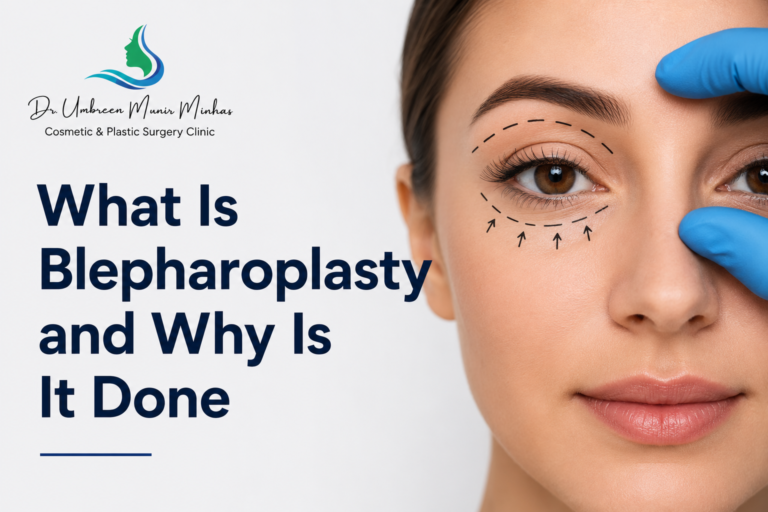
Blepharoplasty is eyelid surgery that removes or repositions loose skin, muscle and fat from the upper eyelids, the lower eyelids or both. The goal is eyes that look rested and alert while keeping their natural shape.

Rhinoplasty is surgery that reshapes the nose by changing its bone, cartilage or both. People call it a nose job or nose surgery.