How Many Sessions Does Tattoo Removal Need?
Most professional tattoos need about 7 to 10 laser sessions to fade fully, spaced about 7 to 8 weeks apart. That means most removals take a year or more.
Tattoo removal in Islamabad with Dr. Umbreen Munir Minhas breaks tattoo ink into tiny particles with laser light, so your body clears it gradually over a planned course of sessions.

Medically reviewed by Dr. Umbreen Munir Minhas, MBBS, FCPS (Plastic Surgery). Last updated October 2026.


 Trustindex verifies that the original source of the review is Google.
 Trustindex verifies that the original source of the review is Google.
 Trustindex verifies that the original source of the review is Google.
 Trustindex verifies that the original source of the review is Google.
 Trustindex verifies that the original source of the review is Google.
 Trustindex verifies that the original source of the review is Google.
 Trustindex verifies that the original source of the review is Google.
 Trustindex verifies that the original source of the review is Google.
 Trustindex verifies that the original source of the review is Google.
 Trustindex verifies that the original source of the review is Google.
The laser sends very short pulses of light into the skin. Ink absorbs the energy and shatters into fragments small enough for white blood cells to carry away through the lymph system.
Each session fades the tattoo further. Clinicians use the Kirby-Desai scale, which scores skin type, location, colour, amount of ink, scarring and layering, to estimate how many sessions you need.
Partners’ names and designs chosen young often lose meaning with time. Fading them can bring real relief, even if a faint trace remains.
Some jobs, families or social settings expect skin without visible tattoos. Hands, neck and forearms are the most common requests.
Eyebrow tattoos, microblading or lip liner can fade to grey, blue or red, or sit in the wrong shape. Careful removal lets you start again.
A few sessions can lighten an old tattoo so a new design covers it neatly. This needs fewer sessions than complete removal.
Dense ink placed at an even depth. Black absorbs laser energy well, so it usually fades most predictably of all.
Reds fade reasonably, while yellow, green, light blue and fluorescent shades absorb poorly and may never fully clear.
Less ink placed unevenly. These often fade in fewer sessions, though uneven depth can leave patchy remnants.
Brow and lip pigments may contain iron oxide or white, which can darken at first. A test spot is done before full treatment.
Dr. Umbreen Munir Minhas photographs the tattoo, checks your skin type and the ink colours, and scores it to give you a realistic estimate of sessions.
Keep the area out of the sun and avoid fake tan before treatment. Tell her about any history of keloids or scarring from the original tattoo.
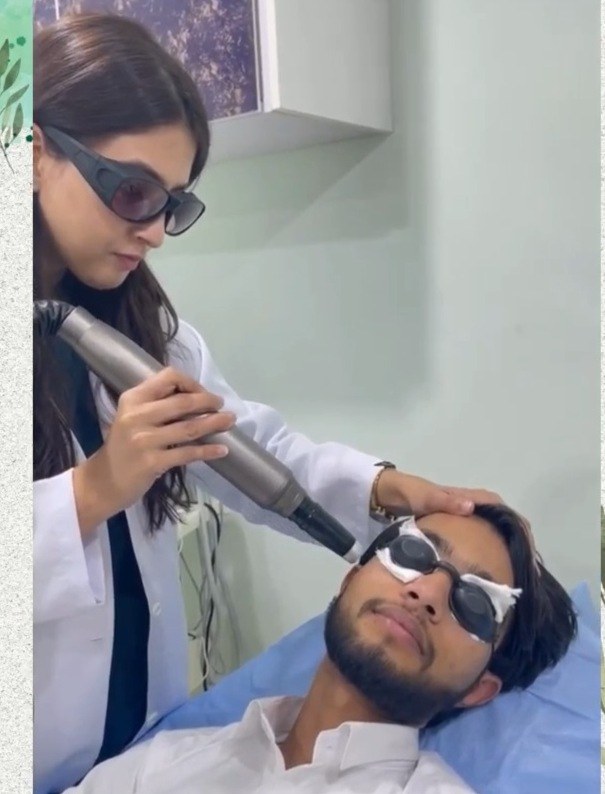
Numbing cream or a cooling device is used, and protective eye shields are worn. The laser passes over the tattoo, which turns white for a few minutes.
A soothing ointment and a light dressing are applied. You can return to work the same day and keep the area clean and dry.
| Time After Treatment | What to Expect |
|---|---|
| Same day | Redness, swelling and a white frosted look. |
| 24 to 48 hours | Small blisters may form. Do not burst them. |
| Week 1 | Thin scabs form and lift off on their own. |
| Weeks 2 to 4 | Skin heals and the ink looks lighter. |
| Long term | Fading continues until the next session is due. |
Do not pick scabs or scrub the area. Keep it covered from the sun, as tanning raises the risk of colour changes in the skin.
Most changes are temporary. With one common laser type, temporary lightening of the skin was reported in up to 50% of patients and texture change in up to 12%.
It cannot remove scars left by the original tattooing, and it cannot promise to clear every colour. Some ghosting may remain.
Your fee is confirmed after assessment, once the size, colours and likely sessions are known. Ask for a per-session price and an estimate for the course.
| Factor | How It Affects Your Fee |
|---|---|
| Size | Larger tattoos take longer each session. |
| Colours | Multicoloured ink needs more sessions. |
| Ink density | Dense professional ink fades more slowly. |
| Goal | Lightening before new ink costs less than full removal. |
When comparing tattoo removal cost in Pakistan, ask for the expected number of sessions, not just the price of one.

As a plastic surgeon who manages scars and skin grafts, she can judge when laser is the right tool and when a small tattoo is better cut out. Your consultation stays private and judgement-free.
Surgical excision cuts out the tattooed skin and closes the wound with stitches in a single procedure.
| Feature | Laser Removal | Surgical Excision |
|---|---|---|
| Suited to | Most sizes and locations | Small tattoos only |
| Visits | A course of sessions | One procedure |
| What remains | Possible faint shadow | A linear scar |
| Colour matters? | Yes | No |
| Anesthesia | Numbing cream | Local injection |
Excision removes all ink at once but always leaves a scar, so it is usually kept for small tattoos in places where a fine line will hide well.
Dr. Umbreen Munir Minhas sees patients privately at Omer Diagnostic & Specialist Clinics (ODC), 12-A, LG Floor, CBC Plaza, G-8 Markaz, Islamabad, Monday to Saturday, 11:00 AM to 6:00 PM.
Tell her how old the tattoo is, whether it was done professionally and if any earlier removal was tried.
Choose a doctor who scores your tattoo, explains which colours may stay and spaces sessions properly. Avoid creams, acids or salt scrubs sold as removers, as they scar skin.
Each pulse feels like hot fat splashing or a rubber band snap. Numbing cream and cooling help, and the area feels like sunburn for a day or two.
Many black tattoos clear or fade to a faint shadow. Some colours and dense professional ink may never fully go, so the aim is the clearest result your skin allows.
Conventional removal often takes 7 to 10 sessions, spaced 7 to 8 weeks apart. In one study, picosecond lasers averaged about 3 sessions, but results vary widely by tattoo.
Yes, with a longer wavelength and careful settings, which lower the risk of light or dark patches. Sessions are spaced well apart to let the skin settle fully.
Yes, once the skin has fully healed after your last session. Lightening the old ink first usually gives a much cleaner cover-up than tattooing straight over dense old ink.
Patient guides on tattoo and mole removal from Dr. Umbreen Munir Minhas’s blog.
Most professional tattoos need about 7 to 10 laser sessions to fade fully, spaced about 7 to 8 weeks apart. That means most removals take a year or more.
A mole is a growth of your own pigment cells, so removing it is a medical decision that may need a laboratory check. A tattoo is ink placed in the skin from outside, so removing it is about breaking that ink down, usually with…
Moles are removed safely by a doctor, under local anaesthetic, using a method chosen after the mole has been examined. The most important safety step is checking whether the mole needs to be sent to a laboratory before anything…