Medically reviewed by Dr. Umbreen Munir Minhas, MBBS, FCPS (Plastic Surgery). Last updated October 2026.
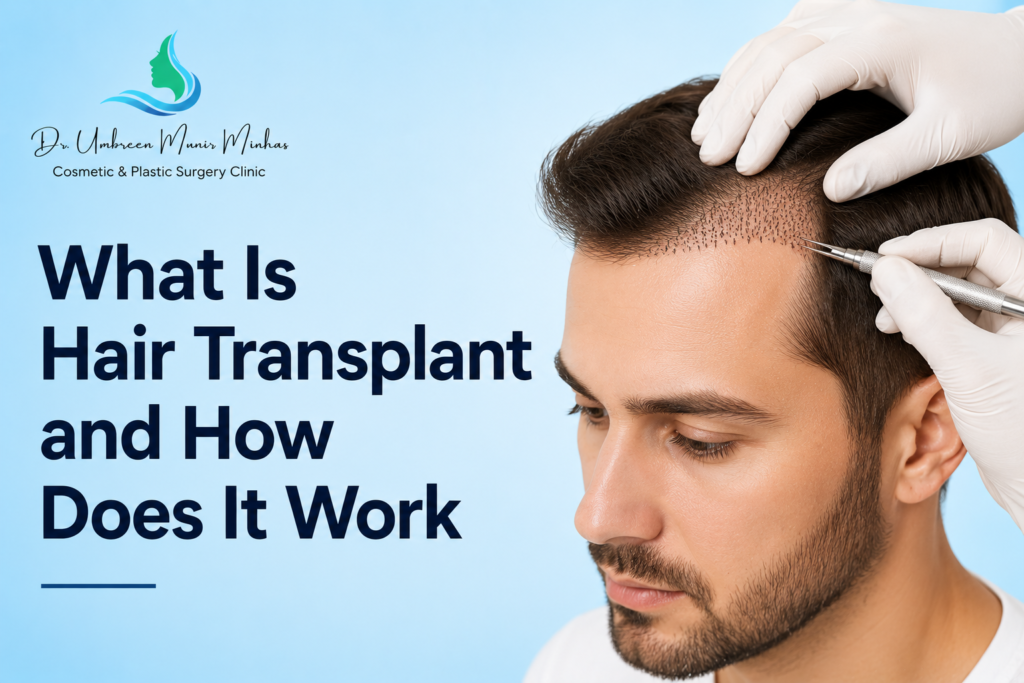
A hair transplant moves healthy hair follicles from the back and sides of your scalp to areas that are thinning or bald. The moved hairs keep growing for life because they come from a zone that resists baldness.
It does not create new hair. It redistributes the hair you already have, so the result depends on how much donor hair you have to spare.
Why Does Transplanted Hair Keep Growing?
In pattern baldness, follicles on the top of the head are sensitive to a hormone called DHT and slowly shrink. Follicles at the back and sides are not sensitive to it.
When those resistant follicles are moved to the top, they keep their resistance. This is called donor dominance, and it is the reason a well-done transplant lasts.
What Is a Graft?
Hair grows in natural groups of one to four hairs called follicular units. Each unit moved is one graft. Single-hair grafts are used at the front hairline for a soft edge, and two- to four-hair grafts are placed behind for density.
What Are the Main Hair Transplant Methods?
| Method | How grafts are taken | How grafts are placed |
|---|---|---|
| FUE (follicular unit extraction) | One by one with a tiny 0.8 to 1.0 mm punch | Into small slits made beforehand |
| FUT (strip method) | A thin strip of scalp is removed and divided under microscopes | Into small slits made beforehand |
| DHI (direct implantation) | One by one, as in FUE | With a pen that opens the skin and places the graft in one step |
FUE and DHI differ mainly in how grafts are implanted, not how they are harvested. For a detailed comparison of the first two, read FUE vs FUT.
What Happens on the Day of Surgery?
- Design. The surgeon draws your new hairline to suit your face and age.
- Preparation. The donor area, and often the whole head, is trimmed short.
- Numbing. Local anaesthetic is injected, so you stay awake but feel no pain.
- Harvest. Grafts are removed from the donor area.
- Sorting. The team keeps grafts cool and moist and sorts them by hair count.
- Placement. Grafts are placed at the correct angle and direction.
Depending on the number of grafts, the procedure takes about six to eight hours. Most people go home the same evening.
How Many Grafts Survive?
When grafts are handled well, most survive. A controlled study found about 92% survival at six months and about 90% at twelve months.
Survival drops if grafts dry out, are damaged during removal or stay outside the body too long. This is why team skill matters as much as the method.
Can a Transplant Stop Further Hair Loss?
No. The transplanted hair is permanent, but your original hair around it can keep thinning. Without treatment, you may later see an island of transplanted hair with thinning behind it.
Many surgeons advise medicines such as finasteride or minoxidil, or treatments like PRP, to protect your remaining hair. These are discussed with a doctor because they have side effects to weigh.
What Else Can Hair Transplant Techniques Treat?
- Beards and moustaches. Filling patchy areas. See beard transplant
- Eyebrows. Rebuilding thin or over-plucked brows. See eyebrow transplant
- Scars. Covering stable scars from injury, burns or previous surgery
- Women’s hairlines. Lowering a high forehead or filling a widening part line
Is a Hair Transplant Painful?
The numbing injections sting for a few minutes. After that, most people feel only pressure and can watch TV or doze during the procedure.
The donor area can ache for a few days afterwards, and the scalp may feel tight or numb for some weeks.
How Do You Know if You Are Suitable?
Suitability depends on your age, the pattern of your loss and the density of your donor hair. Our guide on who is a good candidate for a hair transplant covers this in detail.
Dr. Umbreen Munir Minhas is a female FCPS plastic surgeon at Omer Diagnostic & Specialist Clinics, G-8 Markaz, Islamabad, listed as a hair transplant surgeon. Learn more on our hair transplant in Islamabad page.
WhatsApp Dr. Umbreen Call the Clinic Book a Consultation
Related reading: Hair Restoration.