Medically reviewed by Dr. Umbreen Munir Minhas, MBBS, FCPS (Plastic Surgery). Last updated October 2026.
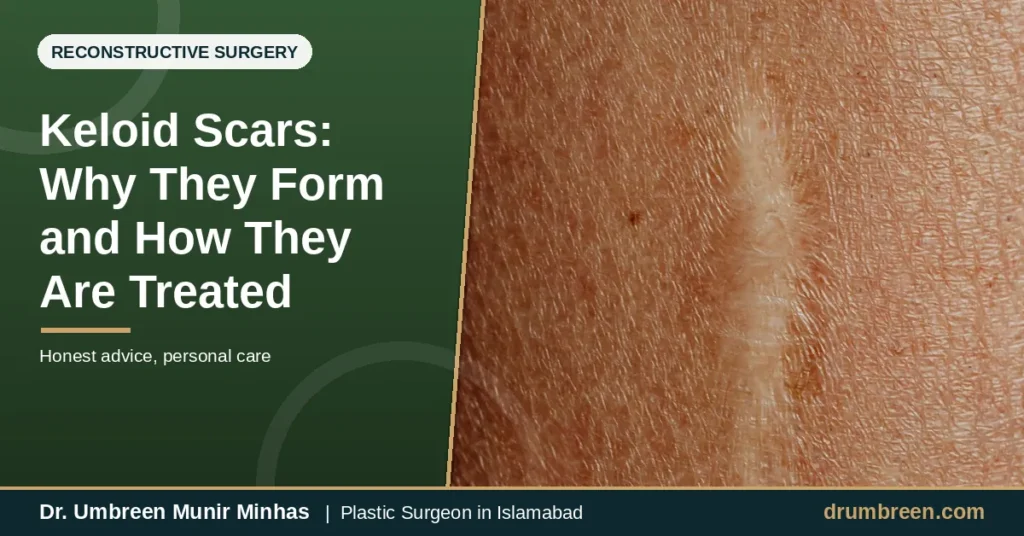
A keloid is a raised scar that keeps growing beyond the edges of the original wound because your skin produces too much collagen while it heals.
Keloid treatment cannot erase the scar, but it can flatten it, ease itching and pain, and slow further growth. Your options range from silicone and steroid injections to surgery in selected cases, and you can read the wider overview on our scar revision page.
What Is a Keloid and How Is It Different From a Hypertrophic Scar?
Both keloids and hypertrophic scars are raised scars, but they behave in different ways.
A hypertrophic scar stays inside the border of the original wound. A keloid grows outward past that border onto normal skin.
| Feature | Keloid | Hypertrophic scar |
|---|---|---|
| Growth | Spreads beyond the wound edges | Stays within the wound edges |
| Over time | Keeps growing for months to years and rarely settles on its own | Often flattens and fades over 12 to 24 months |
| After surgery | Commonly grows back, sometimes larger | Less likely to return after revision |
| Common sites | Ears, chest, shoulders, jaw and neck | Joints and areas where the skin is stretched |
Getting this distinction right matters, because the two scars respond differently to surgery.
Why Does a Keloid Keep Growing After the Wound Has Healed?
When your skin is cut or injured, cells called fibroblasts lay down collagen to close the gap. Collagen is the protein that gives skin its strength and structure.
In a keloid, that repair signal does not switch off. Fibroblasts in the dermis, the thick middle layer of skin, keep producing collagen long after the surface has closed.
The extra collagen builds up in thick bundles instead of the loose basket weave pattern of normal skin. That is why a keloid feels firm, rubbery and raised rather than soft and flat.
Who Is More Likely to Develop a Keloid?
The NHS notes that keloids are more common if you are aged 10 to 30 years. They also occur more often in people of south Asian, Chinese, African Caribbean or Black African origin.
A family history raises your risk, because the tendency to overproduce collagen can run in families. Having had one keloid before also makes another one more likely after a new injury.
Pregnancy is listed by the NHS as another time when risk is higher. Hormonal changes are thought to play a part, although the exact reason is not fully understood.
Which Injuries and Body Areas Most Often Lead to Keloids?
Almost any break in the skin can trigger a keloid in a person who is prone to them. The trigger is sometimes so small that you may not remember it.
- Ear piercing and other body piercings
- Surgical cuts, including caesarean and appendix scars
- Acne on the chest, back and jawline
- Burns, cuts, scratches and insect bites
- Chickenpox marks and vaccination sites
- Tattoos, where the needle injures the dermis repeatedly
The chest, shoulders, upper back, earlobes and jaw are the areas doctors see most often. Skin under tension in these areas heals under more pull, which may encourage extra collagen.
What Does Keloid Treatment Involve at Each Stage?
Most keloid treatment plans combine two or more methods rather than relying on a single step. Your doctor chooses the mix based on the size, site, age and thickness of your scar.
| Method | How it helps | Usually used for |
|---|---|---|
| Corticosteroid injection | Slows collagen production and softens the scar | Most raised keloids as a starting step |
| Silicone gel or sheet | Keeps the scar hydrated and covered | Early scars and aftercare after other steps |
| Cryotherapy | Freezing damages the excess scar tissue | Small and newer keloids |
| Laser therapy | Reduces redness and can improve texture | Red or itchy scars, often with injections |
| Pressure therapy | Steady pressure limits scar growth | Earlobe keloids, with pressure earrings |
| Surgery | Cuts out the keloid tissue | Selected cases, with added steps to limit regrowth |
Treatment is usually a course over several months, not a single visit. Your doctor reviews the scar at each visit and adjusts the plan if growth continues.
How Do Steroid Injections Help to Flatten a Keloid?
The injection most often used is a corticosteroid injection of triamcinolone acetonide placed directly into the scar. Doctors call this an intralesional injection, which simply means into the lesion itself.
Published guidance describes strengths of 10 to 40 mg/mL given at intervals of 4 to 6 weeks. Several sessions are usually needed before you can judge the result.
The steroid reduces inflammation inside the scar and slows the fibroblasts that make collagen. Many patients notice less itching and pain before they see visible flattening.
Possible side effects include thinning of the scar, lighter or darker skin colour around it, and fine visible blood vessels. Your doctor weighs these risks against the size and symptoms of your scar.
Does Silicone Gel or Sheeting Really Work?
Silicone gel and silicone sheets are widely used, but the evidence behind them is weaker than many product claims suggest. A Cochrane review, reference CD013357, rated the evidence for silicone gel sheeting as low certainty.
That means silicone may help some scars, but researchers cannot yet say how large the benefit is. It is still commonly advised because it is simple, low risk and can be combined with injections.
The American Academy of Dermatology advises using silicone sheets or gel for about six months after the wound has scabbed. Sheets need to sit on the scar for many hours each day to have any chance of helping.
If you use silicone, keep the skin underneath clean and dry before each application. Stop and seek advice if you develop a rash, soreness or broken skin under the sheet.
In practice, silicone supports keloid treatment rather than replacing the medical steps above.
When Is Surgery Considered for a Keloid?
Many people ask about keloid removal as if cutting the scar out settles the problem. In practice, surgery alone is the option doctors are most cautious about.
The NHS states plainly that surgery to remove a keloid scar is not usually recommended because it is likely to grow back bigger. The new surgical wound can restart the same overactive healing response.
Surgery is sometimes considered when a keloid is large, hangs from the earlobe, or has not responded to injections. When it is done, it is usually combined with steroid injections, silicone or pressure to protect the new scar.
Techniques that change the direction of a scar, such as Z-plasty and W-plasty, belong to scar revision for tight or poorly aligned scars. They are not a routine answer for keloids, which are driven by excess collagen rather than scar direction alone.
Why Can a Keloid Come Back After Treatment?
A keloid grows back because the underlying tendency in your skin has not changed. Removing or flattening the visible scar does not remove the fibroblast behaviour that created it.
The Primary Care Dermatology Society reports that recurrence rates after any given treatment vary from 9 to 50 percent. Your own risk depends on the site, your family history and how fully you complete the aftercare plan.
Chest and shoulder keloids are known for stubborn regrowth, because the skin there moves and stretches with every breath and arm movement. Earlobe keloids tend to be easier to control when pressure earrings are worn as advised.
This is why follow up matters as much as the procedure itself. Early regrowth caught at a review visit can often be treated with an injection before it becomes large.
How Can You Lower the Risk of a New Keloid Forming?
You cannot change your genes, but you can reduce avoidable triggers and act early on new scars.
- Avoid piercings and tattoos if you or close family members form keloids
- Get acne treated early, especially on the chest, back and jaw
- Protect healing wounds from sun, as ultraviolet light can darken a new scar
- Keep wounds clean and covered while they heal, and avoid picking at scabs
- Watch a new scar for thickening beyond its edges and seek advice early
- Tell any surgeon about your keloid history before planned surgery
Ordinary scars also need time before anyone judges them. A normal scar matures over 12 to 18 months and reaches about 70 to 80 percent of the strength of uninjured skin.
A scar that keeps enlarging past the wound edges during that period is behaving like a keloid rather than a normal scar. That pattern is a reason to book an assessment rather than waiting longer.
When Should You See a Doctor About a Raised Scar?
Book an assessment if your scar is still growing months after the injury, or if it itches, hurts or catches on clothing. Also seek advice if the scar sits over a joint and limits movement.
Early care can slow a keloid while it is still small and softer. Smaller and newer scars generally respond to injections more readily than old, hard and wide ones.
Your doctor will examine the scar, ask about the original injury and your family history, and check whether it has crossed the wound border. Photographs at the first visit help track change at later reviews.
If your concern is a flat, wide or tight scar rather than a keloid, the options differ and are covered under reconstructive care and scar revision planning. A correct diagnosis at the start saves you from treatment aimed at the wrong type of scar.
If a raised scar is growing, itching or troubling you, a consultation can clarify which keloid treatment steps fit your scar and your skin. Dr. Umbreen Munir Minhas is a female FCPS plastic surgeon at Omer Diagnostic and Specialist Clinics, G-8 Markaz, Islamabad, with OPD hours Monday to Saturday, 11am to 6pm, and a consultation fee of Rs 2,500. You can review the scar revision page before your visit and note any questions about your own scar.
WhatsApp Dr. Umbreen Call the Clinic Book a Consultation