
What Is Profiloplasty and Who Needs It?
Profiloplasty is surgery planned to balance your side profile, mainly the nose, lips and chin, as one unit. Most often it means a rhinoplasty and a chin augmentation done in the same operation.
Buccal fat removal in Islamabad with Dr. Umbreen Munir Minhas reduces part of a deep cheek fat pad to soften a round, full lower face, while keeping enough fat for healthy ageing.

Medically reviewed by Dr. Umbreen Munir Minhas, MBBS, FCPS (Plastic Surgery). Last updated October 2026.


 Trustindex verifies that the original source of the review is Google.
 Trustindex verifies that the original source of the review is Google.
 Trustindex verifies that the original source of the review is Google.
 Trustindex verifies that the original source of the review is Google.
 Trustindex verifies that the original source of the review is Google.
 Trustindex verifies that the original source of the review is Google.
 Trustindex verifies that the original source of the review is Google.
 Trustindex verifies that the original source of the review is Google.
 Trustindex verifies that the original source of the review is Google.
 Trustindex verifies that the original source of the review is Google.
Buccal fat removal, also called buccal lipectomy or cheek reduction surgery, removes part of the buccal fat pad, a pocket of fat that sits between the cheek muscles. It is not a weight-loss operation.
The pad holds about 10 ml of fat on average, roughly 10.2 ml in men and 8.9 ml in women.
Some adults keep the full, soft lower cheeks of childhood well into their 20s. The face looks younger and rounder than they feel, and makeup contouring only hides it for the day.
The buccal pad is separate from the fat under the skin. That is why a fit, slim person can still have heavy lower cheeks that do not change with diet or exercise.
When the lower cheek is full, the cheekbones and jawline blend into one curve. Reducing the pad creates a gentle hollow that lets the bone structure show.

Only the part of the pad that bulges into the lower cheek is removed. Leaving the rest protects the face against hollowing as it naturally loses fat with age.
Instead of removing the pad, part of it is moved upward to support the cheekbone. It suits faces that are full low down but flat higher up.
Buccal fat surgery can be paired with chin liposuction or a chin implant when the jawline also needs work. One session treats the whole lower face.
Dr. Umbreen Munir Minhas pinches your cheeks and asks you to clench your teeth. This shows whether the width comes from the fat pad, the chewing muscle or both.
Have any gum or tooth infection treated first. Stop smoking 4 to 6 weeks before, and stop aspirin and herbal supplements 2 weeks before.
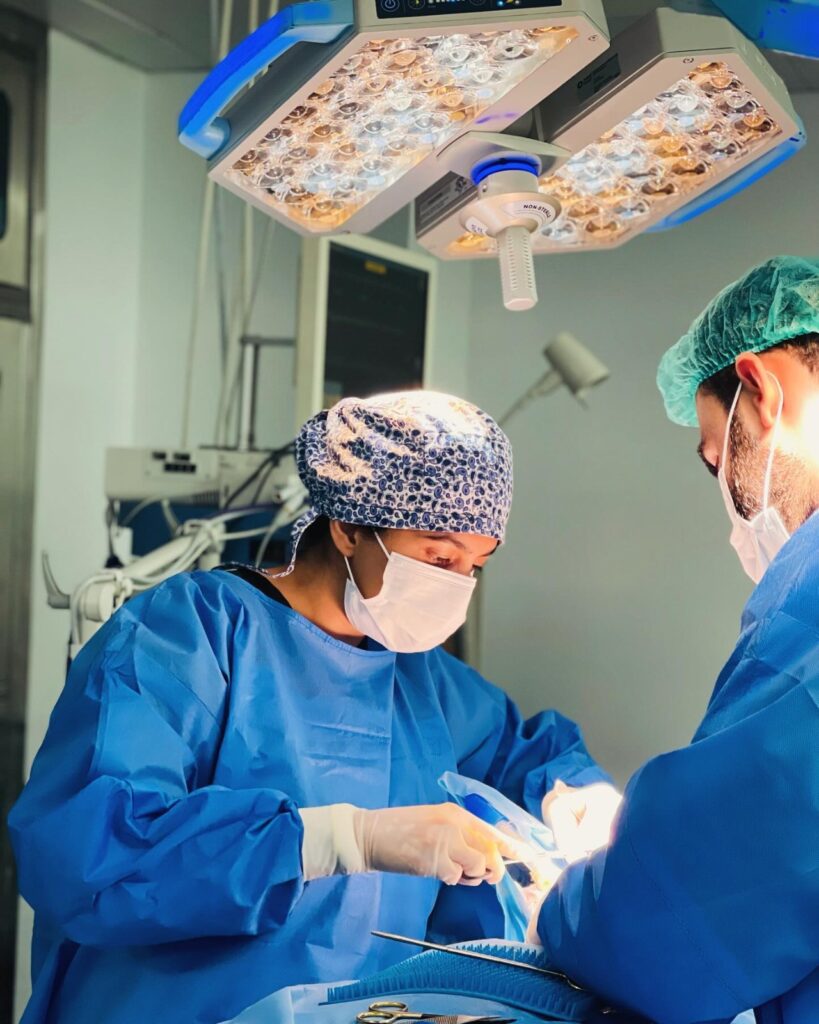
It is usually done under local anesthesia and takes about 30 to 60 minutes. A small cut inside each cheek is used, so no scar shows on the face.
You go home the same day with dissolving stitches inside the mouth. The cheeks look fuller at first because of swelling, not because fat remains.
| Time After Surgery | What to Expect |
|---|---|
| First 48 hours | Swelling is at its peak and opening the mouth feels stiff. |
| Days 4 to 7 | Any bruising shows and begins to fade. |
| Days 7 to 10 | Most people return to work. |
| Weeks 4 to 6 | Swelling has settled and the new contour is clear. |
Eat soft, cool food for the first days and rinse with an antiseptic mouthwash after every meal. Avoid spicy food and smoking until the cuts inside the mouth have healed.
A review of 71 patients found minor problems in 8.45% and no injuries to the salivary duct or facial nerve. Dr. Umbreen Munir Minhas explains every risk before consent.
It does not narrow a wide jaw caused by a large chewing muscle, lift jowls or remove a double chin. Removed fat never grows back, so the change cannot be undone easily.
Your fee is confirmed after consultation, once the approach is agreed. Ask for one written estimate covering surgeon, anesthesia and facility.
| Factor | How It Affects Your Fee |
|---|---|
| Approach | Fat repositioning takes longer than partial removal. |
| Anesthesia | Local anesthesia costs less than sedation or general. |
| Combined procedures | Adding jawline or chin work in the same session raises the total. |
Ask every clinic how much fat will be removed and how much will be left, not only what the operation costs.

Fat grafting is listed on her public profile, so she plans cheek fat with future volume in mind. As a female surgeon, she understands patients who want softer, not hollow, cheeks.
A wide lower face can come from the masseter, the chewing muscle at the jaw angle, which botulinum toxin can shrink without surgery.
| Feature | Buccal Fat Removal | Jaw Slimming Botox |
|---|---|---|
| Cause treated | Deep cheek fat | Large chewing muscle |
| Where it slims | Mid to lower cheek | Angle of the jaw |
| Peak effect | Once swelling settles | About 3 months |
| How long it lasts | Long term | About 6 to 12 months |
| Can it wear off? | No | Yes, and it can be repeated |
In studies, botulinum toxin reduced masseter muscle thickness by about a third three months after injection.
Dr. Umbreen Munir Minhas sees patients privately at Omer Diagnostic & Specialist Clinics (ODC), 12-A, LG Floor, CBC Plaza, G-8 Markaz, Islamabad, Monday to Saturday, 11:00 AM to 6:00 PM.
Bring front and three-quarter photos without makeup, and tell her if you grind your teeth at night.
Most patients feel soreness and tightness inside the cheeks rather than sharp pain. Simple painkillers usually control it, and eating is the most uncomfortable part.
Yes. The removed fat does not return, even if you gain weight. Your face will still change with age, which is why only part of the pad is taken.
It suits adults whose face has finished growing, usually younger adults. In later adulthood the pad is already shrinking, so many faces need volume rather than less fat.
Not directly, because the pad cannot be put back. Hollow cheeks can be improved with fat grafting or filler, but the result is less predictable than the original fat.
No. It changes only the lower cheek area. Fat under the chin, jowls or a wide jaw muscle need different treatments, which can be planned at the same time.
Yes, but with extra caution. Men usually want a strong, square face, and removing too much fat can make the cheeks look gaunt rather than defined.
Patient guides on face surgery from Dr. Umbreen Munir Minhas’s blog.
Profiloplasty is surgery planned to balance your side profile, mainly the nose, lips and chin, as one unit. Most often it means a rhinoplasty and a chin augmentation done in the same operation.
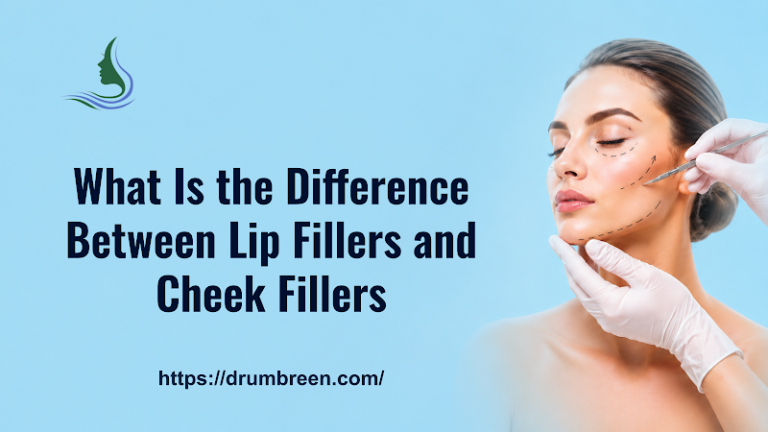
Lip fillers add shape and volume to the lips using a soft, flexible gel. Cheek fillers restore lift and fullness over the cheekbones using a firmer gel placed deeper.

Rhinoplasty is surgery that reshapes the nose by changing its bone, cartilage or both. People call it a nose job or nose surgery.